

Responsible AI
Responsible AI connects the source a model may use, the quality of its answer and the authority required for an action. These responsibilities do not disappear when a system becomes more capable.
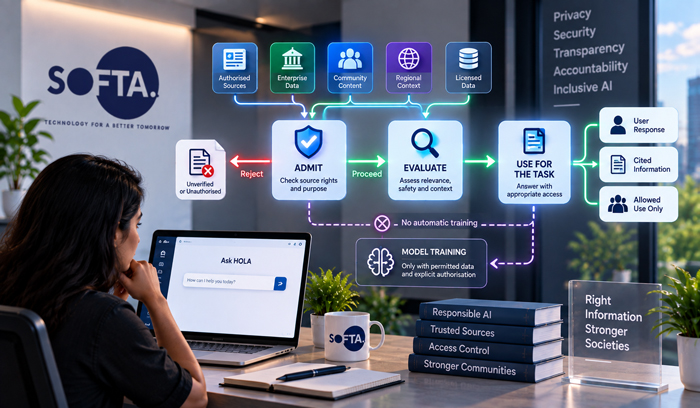
The HOLA constitution begins with source rights, purpose, product authority and regional context. Information is not admitted simply because a shared system can retrieve it. Enterprise access controls and community restrictions must remain meaningful throughout the processing path.
This also requires a distinction between retrieval, evaluation and training. Material permitted for a user’s immediate question does not automatically become a general training dataset. A licence to call a model does not establish ownership of its weights, every output or the information used in a task.
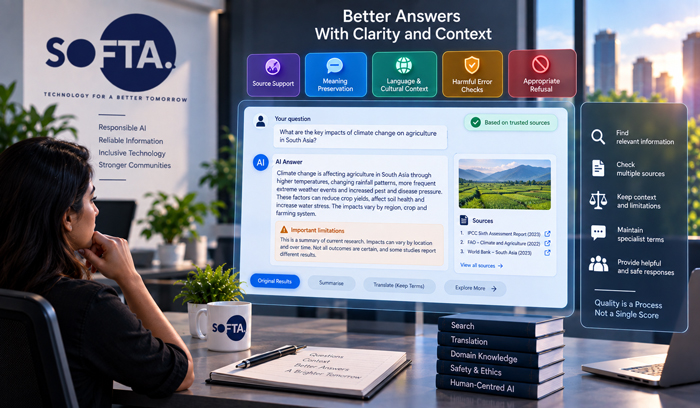
Answer quality involves more than fluency. Source support, meaning preservation, language and cultural context, harmful error and appropriate refusal all matter to usefulness. A summary must retain important limitations rather than produce a cleaner sentence that changes the claim.
For search-assisted work, an original-results path can remain useful when synthesis is inappropriate. For translation, keeping specialist terms and source context may matter more than making every phrase sound natural. The relevant quality evidence is task- and language-specific, not a universal benchmark inferred from a single score.
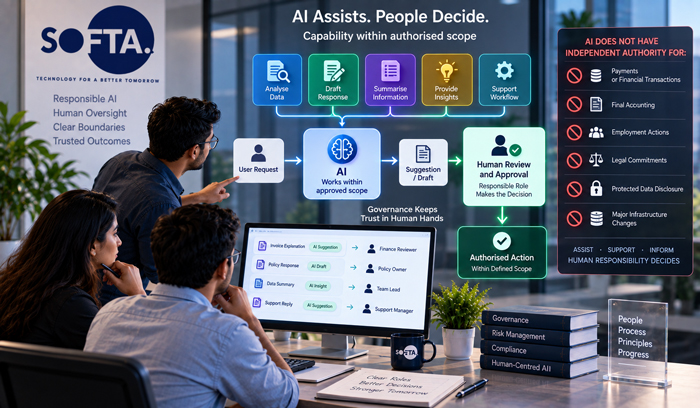
Softa’s governance model does not permit AI to acquire independent authority over payments, final accounting, employment actions, legal commitments, protected-data disclosure or major irreversible infrastructure changes. A system may perform explicitly authorised low-risk work within a defined scope, but capability does not create its own mandate.
An approval must belong to the role responsible for the action. An invoice explanation may help a reviewer while the reviewer and payment authority remain distinct. A suggested response may help support staff, while a consequential account decision still needs the relevant review process.
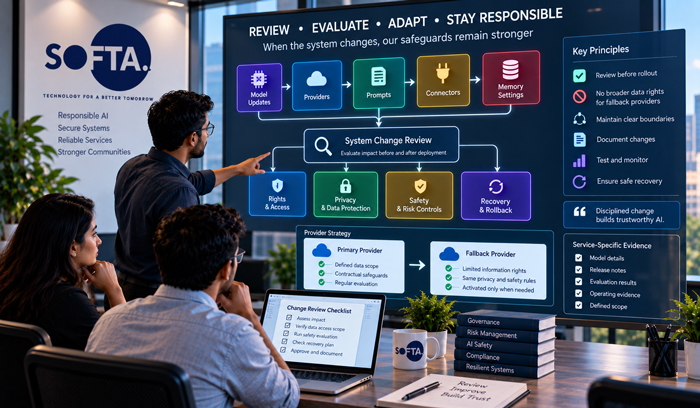
Model updates, providers, prompts, connectors and memory settings can change behaviour. The institutional framework connects such changes to evaluation, rights, privacy, safety and recovery. A fallback provider must not receive broader information rights merely because the preferred system is unavailable.
The architecture is a basis for disciplined implementation, not a declaration that every product has passed an independent AI audit. The service-specific model, release and operating evidence establish the actual scope.
OUR PURPOSE
Softa is building a connected technology ecosystem around privacy, participation and practical human needs creating digital systems designed to remain useful, responsible and inclusive as they grow.
